
CHANGES
Interesting Times

“To everything there is a season, and a time to every purpose under heaven: a time to break down, and a time to build up.” — Ecclesiastes 3:1, 3, adapted
CHANGES
Interesting Times
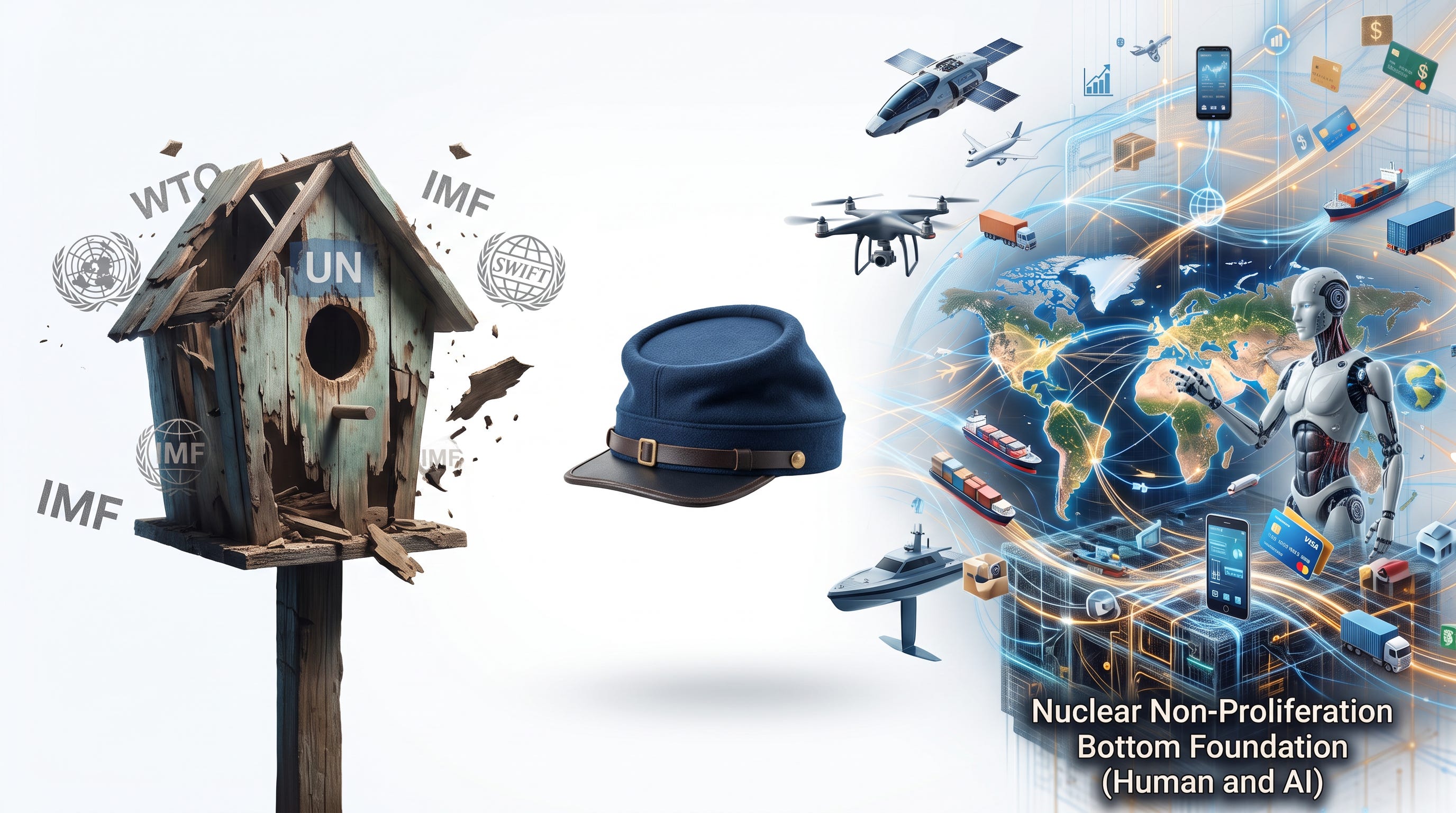
The birdhouse the old order built, the cap the transition wears, and the network already humming underneath both. AIR AI
A birdhouse with the WTO, the UN, the IMF, and SWIFT stenciled on its splintering slats stands on a post, half its roof already gone. Beside it floats a plain kepi, army-surplus blue, belonging to no flag in particular, the kind of cap a provisional government issues when it has authority but not yet an anthem. And beyond both, already humming, a networked world of satellites, drones, container ships, and a half-robot figure reaching into the same fabric that lets a phone call reach home, a card clear at a corner store, a song load without a second thought — labeled, plainly, as a nuclear non-proliferation bottom cap foundation built for human and AI together. Three objects, three eras. The order dismissed since 2022. The transition now in its fourth year. And the next order, already under construction beneath a decade nobody has agreed to name yet.
China’s share of that next order’s global GDP will be around 10 % , much smaller than the United States and its allies combined ( around 60% plus). Russia will be induced toward a ceasefire in Europe by factors that have very little to do with Ukraine itself. Iran’s regime will keep surviving on borrowed time until the crack becomes undeniable. None of these are predictions requiring a crystal ball. They are the shape already visible in this week’s headlines, for anyone reading four movements as one interesting time rather than four separate emergencies.
A birdhouse missing its roof is not proof the birds have nowhere left to nest. It is proof someone is already building the next house, closer than anyone standing under the old one wants to admit.
First Movement
Iraq’s own deadline, the thirtieth of September, given to the Hashd Shaabi militias to disarm or face consequences, cannot pass without consequence if the pipeline detours already routed through Basra and Kirkuk are to mean anything. Mojtaba’s latest nominees inside Tehran read as a radical turn, but the consensus this blog has tracked holds regardless: a cash-starved IRI establishment will keep narrowing its regional ambitions to what it can still afford, which increasingly means cyber and crypto reach rather than proxies on the ground. The USS George Washington’s coming relief of the USS Abraham Lincoln, after two hundred days without a single port call, a new record for time continuously at sea, is Washington’s own quiet acknowledgment that this posture is expensive and not yet finished. Mike Vickers’s read on Tehran’s calculus, that the regime believes time favors it more as elections and economic strain squeeze Washington, is exactly the bet this blog has argued cash arithmetic will eventually defeat.
The CIA’s own low-confidence assessment of the Ankara assassination threat against Trump, quietly disclosed this week even as the Secret Service ran an elaborate deception to protect him anyway, is a reminder that low confidence in a source is not the same as low risk in a theater still capable of producing one. Houthi drones twice struck Aramco’s Jazan refinery this week alone, and Israel’s Katz, walking back remarks that suggested indefinite occupation, has nonetheless ordered the IDF to prepare for an extended presence in the Lebanese south — the same you-first standoff with Hezbollah that has frustrated every round of talks since the ceasefire began.
CENTCOM’s new Task Force Falcon Strike, a genuinely multi-domain, multinational attack-drone force built on Scorpion Strike’s foundation, and the White House’s new digital-privateering directive letting vetted private cyber firms manipulate, degrade, and destroy adversary networks on the government’s behalf, together sketch the toolkit for a solution this blog has floated before: a formal request to Damascus to send Syrian troops into Lebanon to clear tunnels and arms, the same treatment Baghdad is about to apply to its own militias. Beirut, meanwhile, remains tied to its own gang’s corruption on the internal track — an internal pardon approved this week by a parliament that extended its own mandate without an election — while projecting outright impotence on the external one. The independent track cannot be separated from the first movement much longer. It has become one of its symptoms.
A failed Lebanocracy parliament that agrees on an amnesty and pardons its own prisoners lacking fair trials, before it disarms its own militias, has not chosen stability. It has chosen which crisis to postpone.
Second Movement
An Asian factor inducing European peace remains this blog’s working thesis, and the pieces continue arriving on schedule: DPRK guardrails likely to be negotiated in earnest around the UN General Assembly session in New York, an opening expected within North Korea’s own delegation there, setting the stage for Rubio’s October visit to Pyongyang. The real prize, if Washington plays it correctly, is an invitation for Kim Jong Un to the G20 in Miami this December — a diplomatic stroke that would do more to reframe the second movement than another round of sanctions ever could.
Ukraine’s own mysterious new plan, developed with international partners but not yet shared with Washington even as Witkoff and Kushner prepare fresh visits to Kyiv and Moscow, arrives amid an escalating port-strike exchange: Russia hitting Ukraine’s Danube grain terminal, Ukraine hitting Novorossiysk’s own terminals and the Black Sea Fleet’s principal base, Kyiv now proposing a civilian-targets truce that Moscow has not yet formally answered. Putin’s own visit to the disputed Kuril Islands this week, the first of his presidency, lands squarely atop a North Korean missile test and a Chinese submarine-launched ballistic missile test, squeezing Japan from three nuclear-armed neighbors inside a single week. Tokyo’s answer, deepening cooperation with Washington and fortifying its own southern islands, is not militarization for its own sake. It is arithmetic, the same kind Iran is running on cash and China is running on exports.
Three nuclear neighbors pressing the same country in the same week is not a coincidence worth managing quietly. It is a preview of exactly how crowded the next order’s own margins are going to be.
Third Movement
The trapeze act has stopped moving in slow motion and shifted, more dangerously, toward no motion at all — an indecisive momentum inside Beijing’s own leadership that this blog considers the single most under-priced risk in the third movement today. The N-shape correction this blog has proposed since Renaissance needs to begin immediately, not because the theory demands it but because the arithmetic Michael Froman lays out leaves no honest alternative: a trade surplus that reached nearly 1.2 trillion dollars in 2025, solar manufacturing capacity at twelve hundred gigawatts a year against barely more than half that installed worldwide, an auto sector built to produce fifty-five million cars against global demand of roughly ninety million, at a moment China’s own per-capita income, adjusted for purchasing power, sits at roughly half of Japan’s when its own lost decade began in 1991. Beijing has outgrown its own export model, and the reckoning, when the market for new factories finally runs as dry as the market for new apartments already has, will be more painful than Tokyo’s ever was, because China lacks both Japan’s institutional depth and its demographic runway.
Ambiguity over the lost decade’s own start date is doing real work here, conveniently deferring any status-quo change in the Taiwan Strait toward 2039 regardless of how the internal correction actually proceeds. Which raises the open question this blog has not yet answered and will not pretend to: what would a genuine Pacific task force, on the water, above it, and beneath it, built with allies Japan, the Philippines, Taiwan, and Australia, and friends India, Vietnam, and Indonesia, actually change about that 2039 deferral? The honest answer is that nobody yet knows, and that not-knowing, this deep into a no-motion trapeze act, is its own kind of warning.
A trapeze act frozen mid-air is not a pause. It is the exact moment quantum gravity stops being a metaphor.
Fourth Movement
Acceptance cannot protract indefinitely, and the reallocation of global GDP this blog keeps returning to is not a preference. It is, in the plainest sense, inescapable — the entire system as currently weighted is not sustainable, and every movement above is really the same pressure finding a different outlet. Elbit’s Ro’em SIGMA 155, now in live combat, fully automated, firing eight rounds a minute at forty kilometers with no exposed crew, is the tactile version of the robot reaching into the network in this week’s own image: human command increasingly wrapped around an AI-executed core, in artillery just as in cyber. The White House’s own privateering directive belongs to the same story — a government paying private firms to fight at a speed no bureaucracy alone can match, reviving, almost exactly, the letters of marque that once let sanctioned captains do a state’s fighting for it.
War has entered an engineering era faster than governance has entered an accountability one. That gap, not any single battlefield, is the fourth movement’s real frontier.
The Birdhouse, the Kepi, and the Network
Sit with the three objects a moment longer. The birdhouse was never meant to survive on charm alone; institutions built in 1944 and 1945 assumed a world that would keep needing exactly what they offered, and for almost eighty years it did. The kepi belongs to nobody because a transition, almost by definition, cannot yet afford a flag of its own — it borrows authority the way this decade has borrowed patience, one movement at a time, one pipeline detour, one guardroom, one convoy at a time. And the network on the right is not a metaphor for the future. It is already running underneath the birdhouse and the kepi both, moving the phone calls, the streams, the card swipes, the container ships, the set of rules/sanctions that let any person move almost anywhere in an arriving order whether or not anyone has agreed to name it yet.
There is a time to break down and a time to build up, and the useful discipline is to realize that both can be currently underway. The birdhouse is still standing, technically. The kepi is still floating, unclaimed. And the network keeps humming regardless of which era anyone thinks they are living in. Changes are natural chapters of the times.
— Elie K. Nammour | Assisted by Claude · 4EKN 2026